Arwen's meanderings

Hi everyone and welcome to my dinghy cruising blog about my John Welsford designed 'navigator' named Arwen. Built over three years, Arwen was launched in August 2007. She is a standing lug yawl 14' 6" in length. This blog records our dinghy cruising voyages together around the coastal waters of SW England between 2009 and 2025.
Arwen has an associated YouTube channel so visit www.YouTube.com/c/plymouthwelshboy to find our most recent cruises and click subscribe.
Although 'Arwen' has now been sold to another family and is sailing in new water, this blog will remain a source of inspiration and information for those interested in dinghy cruising and sailing the local waters around Plymouth Sound. So, continue to drop us a comment or ask a question and happy sailing and fair winds to you. Steve and Arwen
Steve and Arwen

Tuesday, 7 May 2019

making wooden oars for a dinghy 4

From this................

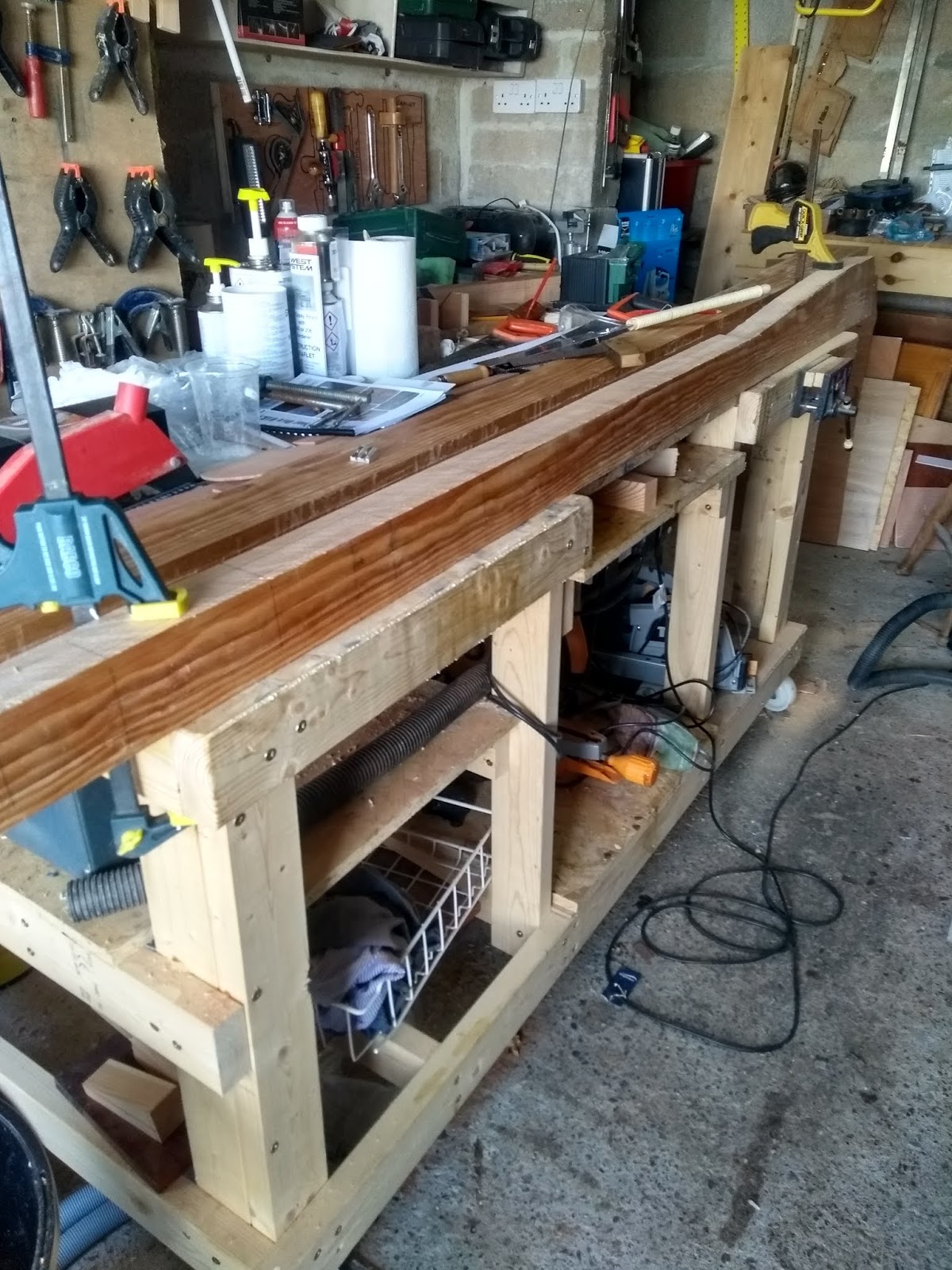
...............to this.................

The smell of fresh Douglas Fir shavings - those tight whorls. The swish of a finely tuned spoke shave. Finely tuned fingers and eyes searching out ridges to shave down.

Straight?.....Er....no.
Pretty?......Er nope!
Symmetrical?.......You're hav'in a laugh aren't you.
Balanced?........Just!
Workmanlike? Absolutely!

One oar rough cut and almost rounded - need sanding; the counterweight block end needs smoothing. The blade needs shaping. The transitions from square to round loom and from loom to blade need transitioning.

Still lots to do and this is only the first one!

Monday, 6 May 2019

Safety considerations in your boat


Further to my discussion a few posts ago about what to carry on a PFD as safety equipment, I’ve done a little more pondering. This was bought about by a comment from a reader who asked how easy it was to get back into Arwen with a fully inflated life jacket on.
Well I have no idea actually but I suspect pretty difficult. I know that my old jacket can be deflated using the end of the cap which goes over the oral inflation tube. But how easy would it be to do that when bouncing around in waves with spray over your face whilst trying to hold onto a boat which had capsized? It is nigh on impossible to swim with a fully inflated life jacket that’s for sure, since you are lying on your back.
So, in truth, I suspect that I will continue to rely on my Palm Kaikoura PFD and the life jackets will be for any guests on board Arwen although both her indoors and daughter, when they come sailing, prefer close fitting over the head style PFD’s as well – apparently, they are warmer!!
Now to the issue of accidently falling overboard, I remember reading somewhere that most dinghies will luff up into the wind automatically because of the loss of the weight of the crew member and as long as he or she didn’t cleat the main or tiller. Now I confess I’m not sure that Arwen would be that considerate, thus on longer voyages along the coast, I tend to clip myself into a harness. I can install temporary jack lines which run down one side of the centre-case and which are secured in aft footwell and on forward centre-case plank by shackles through bolted deck eye pads. The harness is 2m long and slides along the jack lines meaning that I can move freely along the length of the boat unimpeded. When wearing my PFD, I also have a harness bib affair that goes over the top of it into which the harness tether clips.
The greatest times of risk for MOB are when I am moving along the length of the boat, or when dropping mainsail and tying in a reef or two. Otherwise, Arwen has quite a good freeboard on her and I sit well inside her with a back rest and side deck between me and the sea.
When it comes to capsize, an unladen Arwen was fairly easy to upright in calm seas. However, a laden Arwen in waves would be a different beastie and I work on the assumption that she would be swamped. Righting her in such conditions could be hit ad miss. I have installed knotted righting lines to help me turn her over sufficiently that I could reach for the centreboard, but of course, many factors come into play at this point. The weight of my wet clothing, for example, how exhausted I am, how long I have been in the water, the rate of drift, wind speeds, etc.
For getting back over the gunwale I installed some tape loops that can be pulled from under the side decks. They run the length of the hull, either side, and dangle about 20” or so below the gunwale. I can get a foot onto the strap and then push away from the hull slightly so that I almost get into a standing position alongside the hull, sufficient that I can then topple over the gunwale into the swamped cockpit.
A manoeuvre that would be somewhat difficult in a fully inflated life jacket!

Friday, 3 May 2019

making wooden oars for a sailing dinghy 3

That 'dur' feeling when you discover the Japanese saw blade was angled slightly as you sawed through wood and removed more on one side than the other so that now you have to glue cut pieces back on....oh I wish I had a BIG band saw............"BIG sigh"...........................


My father was a skilled engineer........genetically where did that skill set go?

making wooden oars for a sailing dinghy 2


My new oars will be 9’6” in length and will be stored along Arwen’s side decks. The blades will hang over the stern and the handle ends will end up roughly where her front coaming curves. Resting in their rowlocks, the upper part of the oar looms and handles may interfere with the jib sheets, so some trial and error over fitting will be required.


I may also have to fit some new rowlock pads, again a matter of trial and error. When I row Arwen, I remove the compass on her centreboard case top and put a small padded cushion over it. I then sit on the centreboard top. The rowlocks are situated around 10” aft of my upright position. The blocks are attached to the coaming sides and they are around 2 ½ “ in depth. Thus, the oars in their rowlocks normally clear the side deck gunwales when in use.  I tie the oars to the rowlocks with loose cord and the rowlocks themselves are also secured to the boat. In the event of a capsize, everything should stay attached although I suspect it will be a holy mess!


Where I think I will need to do some further thinking and adjustments, although I am, for the moment, not sure how – is over the matter of how much lower the centreboard seat top is to the position of the rowlocks.


My Oars are based on CLC plans and have counter-weighted looms and round cylindrical handles. The looms will be 46mm in diameter and square section. Made of Douglas fir, I will use 10” long leather protectors where they pass through the rowlocks. These will be stitched on rather than copper tacked. The ‘drip’ collar bits will also be thin leather strips wound tightly around the loom a few times, contact bonded.  I did read somewhere that these should be lubricated with Vaseline that will make them smoother and easier to move! I think some people also lubricate the rowlocks in their sockets as well. Oar blade tips will be fibreglass taped.


Regarding the lanyard arrangement on my rowlocks, the lanyards are tied on at the neck below the rowlock horns with 2mm cord and then threaded through the rowlock where the end is secured to the underside deck. I tend to keep the rowlocks in permanently as the oars rest along the side decks. I’m not really sure whether this is seaman like or not.


As to the finish of the oars? Well, linseed oil is one possibility but Roger Barnes informs me that this will turn to the oars black. I am leaning towards using Le Tonkinois since touch up coats are easily applied and wiped down. The handles will remain untreated, an attempt to avoid blistered hands!
Well, that’s the plans. Of course, it is back to cutting out the blanks and then shaping them. Lots of work to do before finished can be applied!


Hand cutting oars with just a Japanese pull saw is a time consuming and tiring affair, satisfying but tiring. It is tricky to keep the blade vertical and already I have noticed that the blank looms aren't quite as square as they should be. I'm hoping this will sort itself out when I start rounding them. 

Monday, 29 April 2019

Travelling around The Roseland area in Cornwall

Spent a week down in the caravan, cycling around the Truro area. Now clocked up nearly 600 miles on new electric mountain bike. Getting around 40 - 70 miles on one battery charge depending on what mode I am in, how many steep hills I encounter and how windy it is.

Must go back down to the Fal sometime this year for a week's sailing up the Fal and its estuaries and across to Helford. Can't quite decide whether to sail down via Fowey or Mevagissy or whether to trailer Arwen down.

Anyway, a few pictures from this week's adventures.

Watching surfers at Portreath


Falmouth and Mylor


St. Mawes and Mevagissy


In the meantime, hoping to make my first Dinghy Cruising Association rally this weekend, up to Calstock on the river Tamar but it is contingent on getting the caravan fixed. Sadly the Al-Ko ATC mechanism wouldn't work properly and whilst the caravan hitched to the tow bar correctly, the anti swerve and ATC control wouldn't engage. It was a 'gingerly' drive back home today and the van is booked in tomorrow for a health check and diagnostic. I suspect they will keep it for a few days and then we, hopefully, will collect it at the weekend. 

Meanwhile oar wood working continues. without a band saw it is slow going, even using the jigsaw. I am finding that hand cutting out the blanks with a Japanese pull saw is the surest method at the moment. I'm in no rush and it is nice to slowly rough shape something. I am sure people could get it done in a third of the time I will take but then I always have a 'unique' way of getting things done - if there is an easy way and a hard way......well you know which way I end up going !!


Friday, 19 April 2019

Dinghy cruising in a Welsford navigator - oar making 5

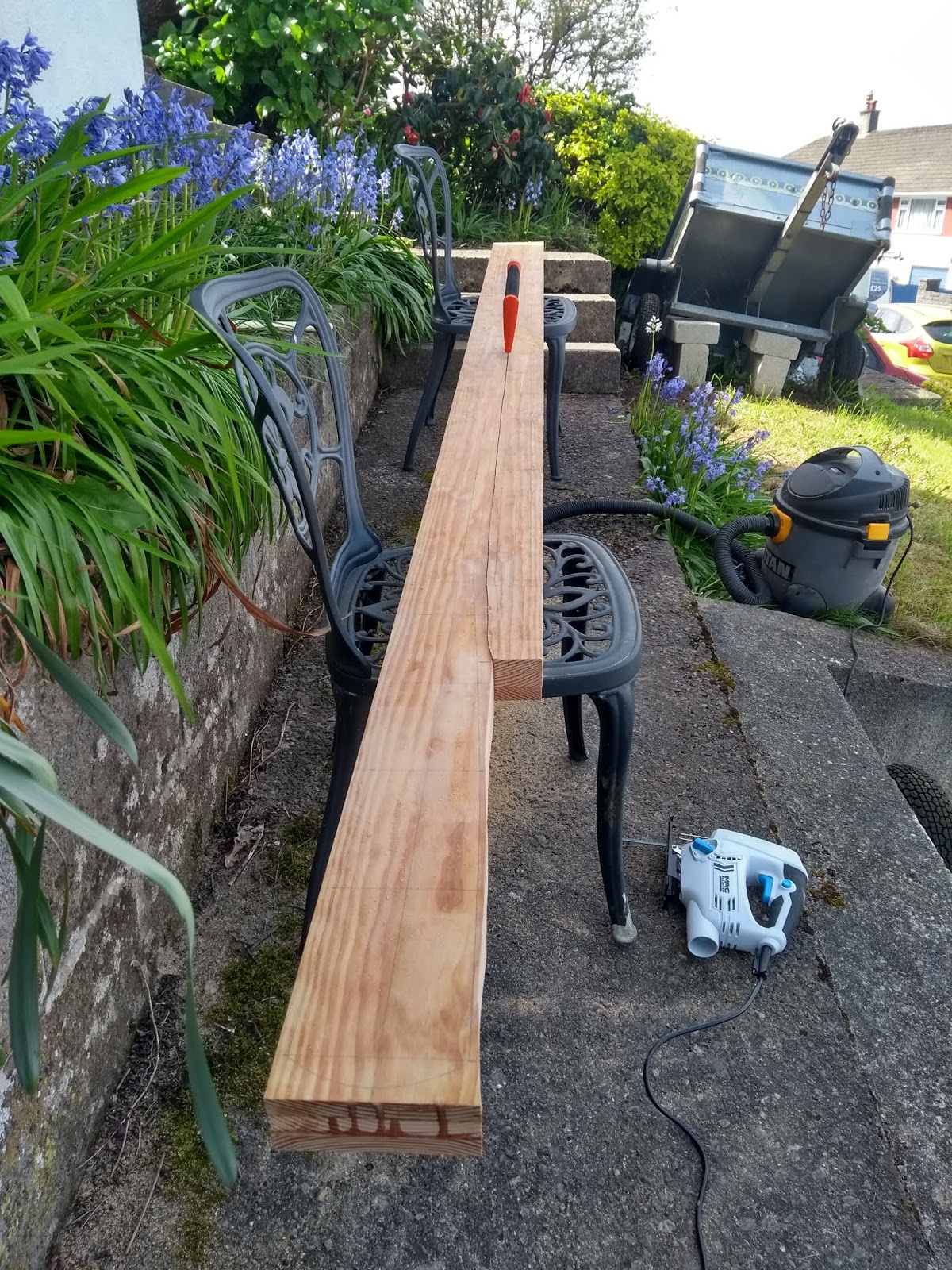
When you don't have a band saw that cuts a straight line, oar making can be tricky. Having laminated three planks and cleaned up the epoxy dribbles, it was time to rough cut out the two oars. Starting by marking on the oar outlines, jigsaw, Japanese saw and handsaw were gathered and the plank laid out on two chairs.

wooden oar blanks

The jigsaw was tough going even with new blades and pendulum action and so most of the plank was cut using the carpenter's handsaw. Suffice to say, just cutting the plank in two took over an hour!


Now, its time to make a series of vertical little cuts up to the marked out lines before then returning the oars to the chair set up and vertically close trimming the oars to the marked lines. Thus will pass at least another day in cutting wood. After that, the side profiles will be marked on and the vertical cutting will start all over again.


Oh what I would give for a decent band saw!

Thursday, 18 April 2019

Dinghy cruising a Welsford navigator - oar building 4

Clamps off. Epoxy set. drips knocked off and planed down.
Plans drawn onto top board.

Now ready for cutting out.

Making wooden oars for dinghy


Sunday, 14 April 2019

Dinghy cruising and personal safety equipment to carry on your person


What safety equipment should solo dinghy cruisers carry on their person when sailing?

Recently ran into an old canoeing buddy from a very long time ago and we had a quick chat about the new PFD he had just bought. Apparently, the foam within his old one had lost some of its buoyancy each year – go figure! As he readied his new one, we chatted about the personal safety equipment he carried in it and why it was there and he briefly showed me a couple of articles on the web that had influenced his thinking about what equipment Sea Kayakers and small boat owners should carry on their person.   Just wish I could remember which ones he showed me but anyway back in the car on the way home, our conversation set me thinking – always a dangerous situation given my propensity to over think and complicate the simple!
  •        Has my PFD lost buoyancy so that it will no longer support my ample weight in the water?
  •       Do I carry so much personal safety equipment in the pockets of my PFD that I’d sink more in a MOB emergency? (had one or two comic nightmares about that scenario)
  •       Given the sailing I do, do I actually need to carry that gear at all?
  •       Carrying so much safety equipment in the pockets, have I made the PFD too bulky and a liability in event of a capsize? Will it make climbing back into Arwen difficult or snag on something during a capsize?

Let’s set some brief context.

My PFD is a ‘Palm Kaikoura Expedition’ which I have now had for around 6 years or so. It has, fortunately, rarely been in the water and only tested with me inside it once! The PFD can be can be seen in most of my YouTube videos.  Hard wearing, a snug comfortable fit, easily adjusted with plenty of pockets for bits and pieces and tough zips, it has an anti-ride waist belt and I’ve attached a crotch strap as an additional safety feature. Fleece lined hand warmer pockets (luxury indeed), strong D ring clips for attaching various items, lots of tapes for clip on attachments and plenty of reflective patches all round. It comes highly recommended by a number of sea kayakers' and river canoeists I know. I love mine and my only gripe is the smaller zips keep salting up from spray and then bind. One has finally broken and at some stage I need to take it out and replace it.


My other PFD was a thoughtful Christmas present this year – one new Crewsaver comfy fit life jacket, auto inflate, with safety harness D ring attachment loops. Her indoors says that whilst I am very well insured and she stands to gain a large sum of money in the event of my demise, I am for the moment, worth keeping around and therefore an auto-inflate life jacket is a good investment. Knowing I’m absent minded and clumsy, she worries that Arwen’s boom might hit me on the head during an accidental gybe or I drop the top yard uncontrollably, whilst sailing the coast and I go overboard unconscious. She dreams – sorry thinks – of everything – bless her!

Most of my sailing is around Plymouth Sound, along the inshore coast between Dartmouth and Falmouth and up the tidal rivers in-between and I tend to solo sail with no other boats in attendance, up to three miles or so offshore.  On most trips to Salcombe or Fowey (about 23 miles or so in length) I normally see a boat or two along most parts of my passage.  Along this coast there are lifeboat stations – Salcombe, Plymouth, Looe and Fowey and whilst I passage plan to never get into trouble so I have to call them out, I guess in a worst-case scenario, when I do, they are about 20 – 30 minutes away from that first call to coastguard. Worst case scenario, in my mind, for me, is to go overboard and become separated from Arwen or to be unable to right her after a capsize.  
On calm-ish days when winds are below 10 knots, I wear the PFD. Within the Sound and up tidal rivers, I always wear the PFD. Sailing an extended inshore coastal passage to Salcombe or Fowey for example, I wear the PFD in light winds but 10 knots + or if there are any potential large gusts, then the life jacket. Random thinking, I know, but those tend to be the habits I have developed. More often than not, I clip myself onto a harness attached to jack lines when doing an extended coastal passage, irrespective of weather conditions. And yes, I know, there is huge debate about whether I should or not – pros and con’s abound on the use or otherwise of harnesses when dinghy cruising.

So now with suitable context set, back to the questions:

Has my PFD lost buoyancy?  Only one way to find out and that is to pop down to a local marina and test it.   


Do I carry so much personal safety equipment in the pockets of my PFD that I’d sink in a MOB emergency? (had one or two comic nightmares about that scenario)
Given the sailing I do, do I actually need to carry that gear at all?  

From a few years ago - since then I carry different stuff and it is arranged as outlined below


Listed below, the equipment I normally carry routinely in my PFD -
·        Floating waterproof ICOM handheld VHF – either clipped to one of the tether straps on PFD front or in RHS large pocket with aerial poking out between double zip – either way attached with security lanyard as well. (Note - not the one shown in the picture above which now resides in a grab bag). 
·        Mobile phone in water proof pouch which tucks down inside the front of the PFD when worn – another lanyard attaches it to shoulder strap.
·        SPOT PLB Messenger – clipped and lanyard to front of jacket tether strap – left hand side
·        Laser signal strobe light attached to left hand shoulder strap
·        In LHS large pocket
o   folding safety knife on one metre long lanyard tied onto internal pocket D ring
o   Plastic whistle on bungee lanyard
o   Waterproof plastic pouch containing money credit card, emergency contact numbers and driver’s licence and car key – tied to other D ring
·        In RHS pocket, apart from VHF
o   Signal mirror and spare whistle
·        Small front RHS pocket - small 30mg sunblock and lip salve stick, foil wrapped energy bar
·        Small front LHS pocket - waterproof handheld GPS unit
·        Attached to right hand shoulder strap, a locking carabineer so I can clip in the grab bag (my grab bag should float free of Arwen in a capsize if I didn’t have time to grab it when going overboard – contents of grab bag are outlined at end of this blog post).

Does all this fit onto the new life jacket?  Of course not. The moment it inflates – this lot would impede the bladder and I’d sink! After some experimentation, I have found a way of clipping the radio to the waist belt out of the way of the inflated bladder and likewise with the PLB. The rest of the items I put into a specifically designed life jacket waist belt accessories bag – who knew such a thing existed – and it sits around the back of the waist belt out of the way of the inflation bladders. I have tried it and it I can sit comfortably with it just located under my armpit area.

Which now brings me back to the sixty-four billion-dollar questions. Am I carrying too much? Do I need to carry any of this at all?  I genuinely have no idea and I guess it’s down to personal choice and what makes you feel safe. Hand held VHF radio effectiveness is limited by height and so I’d likely have a range of 2 miles tops when in the water – so I’d be reliant on other boats being in the vicinity.  Mobile phone coverage might be better if I’m not under steep cliffs – 18 miles perhaps even if in the water. The PLB will work wherever I am – it has an emergency flip up button. Of course, I have to be conscious to work all three of these things! Signal mirror for daylight; strobe light for failing light or night time rescue. GPS for mayday message location details to coastguard – if of course I hadn’t lost my reading glasses during the MOB or capsize. Suns screen and lip salve – well I could just keep those in a ditty bag but they don’t way much or take up huge space and its just convenient having them in a pocket.  Cash and keys obvious really – if Arwen is lost and I am rescued – I need to retrieve the car etc.

      Carrying so much safety equipment in the pockets, have I made the PFD too bulky and a liability in event of a capsize? Will it make climbing back into Arwen difficult? Will it snag on something during a capsize?  

      Not sure. Some YouTube viewers have commented on the bulkiness of the PFD. I have righting lines and re-entry loops attached to Arwen along with a transom footstep. Whilst swimming last year in the PFD I found re-boarding Arwen at anchor fairly easy. But and it is a big but, the PFD was practically empty, the conditions calm and Arwen still and unmoving.  Could things get snagged? When I think of this factor  I am reminded of poor Emily Gardner, who at 14 yrs old, tragically drowned because she got her poorly fitted PFD caught on a cleat of a powerboat during a capsize.  I wear my PFD snug fit – tensioning straps, waist belt and anti-ride up belt all correctly tightened. Potential snag areas are the radio and the strobe light if I wear them on the shoulder straps or PFD front panels. Possibly the crotch strap as well. These could hook up on a cleat I guess but in truth I  just don’t know in reality.
So, there we have it. I know that some boaters who I have met out on the water or at the ramp or pontoon have commented on my PFD. The Plymouth lifeboat crew in the main seemed OK with what I carried and how it was arranged when I bumped into them one day the year before last at a launch site. They thought I and Arwen were well equipped and wished me a good day’s sailing and were off.  Others have commented the PFD is too bulky for them and they prefer slim fitting ones – fair enough.  A few joked about my increased sinking potential.

At the end of the day I guess it is down to personal choice and whatever floats your boat. If you have any thoughts on the matter, as always, let me know in the comment box below. Informed discussion and observations welcomed, I love learning new things and hearing the wisdom of sailors. Take care now and enjoy your trips out on the water.  


Foot notes:
I have a grab bag on board Arwen -  yellow, waterproof roll down with shoulder strap. Arwen’s name and an emergency contact number in waterproof ink on the front. It resides on the front thwart top, just under the foredeck, held by bungee over the top of it. It is easy to pull free. In the event of a capsize where I can’t right the boat God forbid, I can pull it free.  What’s in it?
·         - Orange bivvy bag and space blanket
·         - Spare VHF, handheld GPS unit and batteries for both
·         - Bottles of water and emergency high energy snack bars
·         - Lip salve and sun cream
·         - Spray hood, spare sunglasses, whistle
·         - Torch and spare batteries
·         - Orange floating smoke can
·         - Sealed fire-starting kit (I have no idea why – but if washed into some inaccessible cove that has         driftwood, I can start a fire!)
·         - Small first aid kit for cuts

Saturday, 13 April 2019

Dinghy cruising a John Welsford navigator, oar building part 4

Sssh!

Trying to find somewhere to hide the receipts from 'Her Indoors'!


The smell and crumpling sound of that lightly oiled brown paper.....a joy to my ears.
And there is a spare blade as well.  


Look at the teeth on this bad boy - awesome! 

New Jigsaw with extra new blades and the Japanese pull saw should see off most eventualities on this oar building adventure