I
recently posted a question on the Dinghy Cruising Association Facebook forum
page.
“Afternoon fellow DCA’ers.......remembering there is no such
thing as a dumb question.....and you don't know what you don't know.........do
any of you dinghy cruisers (particularly here in UK) carry some form of
Personal Locator Beacon or personal emergency radio device of some form (other
than VHF radio)? If so, what do any of you carry on your person or recommend?
Or is a handheld VHF, mobile phone and flares enough? By the way my handheld
VHF doesn't have a DSC button”
Of course,
I wrote this before all the lockdowns and enormity of our changing lifestyles
here in the UK – when I was dreaming of sailing down to Falmouth via Fowey and
Lostwithiel; calling back in Mevagissey and so on. Ah well, maybe next year.
Anyway,
seventy odd comments later – Roger Barnes, the President of the DCA and I have
concluded that perhaps my question wasn’t as stupid as it might have first
appeared!
So
below I share what I have learned from internet research and Facebook Dinghy
Cruising forum members. I cannot guarantee that all this information is
accurate so it may need further checking.
Starting
at the beginning - when I am sailing Arwen, clipped to my jacket or in an under-armpit
lifejacket belt bag or within the pockets of my Kaikoura Expedition PFD if I
happen to be wearing that, I carry the following items:
· SPOT PLB
· Safety knife
· Mobile phone
· Waterproof, floating handheld ICOM
VHF (not DSC enabled)
· Flashing lifejacket laser light
· Safety mirror and whistle
· Hand held Garmin etrex GPS
· Lip salve and tiny 30ml sun cream
bottle
My
SPOT PLB device, a subscription model, takes about 20 seconds to get a
satellite fix using a combination of globalstar and GEOS satellite networks. It
has several useful features from sending ‘check-in’ texts to family to an SOS
emergency call for help button and ‘tracking’ feature. Its particularly useful
when creek crawling far inland on tidal rivers in steep sided river valleys
where there is no mobile phone signal as I can ping an ‘I’m OK’ message to the ‘boss’
just before going to bed reassures her that I’m still alive. Further details
can be found at
So, why am I thinking about
carrying an additional personal emergency beacon of some form?
Well, firstly SPOT
is a subscription service – and that adds up over the years. Secondly, it takes
around 20 seconds to get a satellite lock, the face of the unit has to be
facing skywards and the SOS goes to an emergency rescue co-ordination centre in
the US which then contacts the UK Falmouth Coastguard rescue centre or the UK
Police – depending on whether the SOS is coming from the sea or land. That’s
quite a delay factor Whilst I’m floating around in the sea, adrift, waiting for
people to contact others to then alert rescue services here in the UK! Although
it is claimed it is fully waterproof and can be submerged – I’m not truly
convinced about that either!
Well you can see the issues. So,maybe
it is time for something more ‘immediate’.
There are lots of devices out
there and I guess it depends what kind of sailing you do. For me, I do lots of creek crawling up my
local tidal rivers and then the occasional jaunt inshore along the coastline –
up to four nautical miles off shore. Most of my day trips are done within
Plymouth Sound or up the River Tamar and there is normally some boat traffic
around – Navy boats, MOD police, tourist boats, local inshore fishermen,
recreational yachts and various small foot ferries shooting between various
quaysides.
So, what’s
available if I want to get a new personal emergency radio device for next year?
One set of devices are basic ‘alerting
technology’ – they alert others that you are in distress but may not
update rescuers about your location. These would be things like VHF DSC
– sending distress messages to your own boat and nearby boats using an inbuilt
Global Navigation satellite system (GNSS). The message gets repeated and only
stops when acknowledged. Locating technology is needed by rescuers to help
locate you and there are transmission limitations to VHF, especially if you are
in water with waves which can block signals. (Basically, it is a line of sight
technology). VHF DSC is monitored by the UK Coastguard and all SOLAS vessels.
Then there are devices which use 406
MHz Cospas-Sarsat – which send distress signals through the Cospas-Sarsat
satellite system to a rescue co-ordination centre. If you get such a device, ensure
it has GNSS technology, for without it, it can take up to two hours to
achieve a position with an accuracy of 5km apparently! Such devices have to be registered with the
UK Coastguard. Having transmitted the alert these devices then continue to
transmit updated positional data (remember GNSS is far more accurate at this)
to the Rescue co-ordination centre which then forwards it to any rescue craft.
One thing to note about 406 MHz Cospas-Sarsat technology is that it will not necessarily
alert nearby boats to your distress.
There are EPIRBs (Emergency
Position Indicating Radio Beacon) which are registered to your vessel. Some
also use 121.5 MHz homing beacons as well and newer ones will also have AIS
(see below for further details) which will send AIS messages to any AIS
equipped vessels in your vicinity – which speeds up your rescue chances.
Then there are some 406 MHz PLB’s
(Personal Locator Beacons). Used in life or death emergency situations to alert
SAR to your location, new ones are accurate down to 100m. Many of the newer
models also have the 121.5 MHz homing beacon as well. PLBs are programmed to
individuals and have to be registered with the local authority rescue
coordination services. I would also advise making sure that your PLB of choice
is either IPX7 – waterproof up to 3’ of water or more ideally IPX8 – waterproof
in more than 3’ of water.
After ‘alerting technology’ there
is then ‘locating technology’ which helps rescuers find you.
Remember though, it doesn’t alert then to your distress in the first
place. Some devices use AIS
(automatic identification system) which broadcasts your location to all vessels
fitted with AIS receivers within VHF range (up to 5 miles range to all SOLAS
vessels, UK rescue helicopters and lifeboats). AIS will update your locational
position regularly on AIS enabled chart plotters etc. They are often marketed
as MOB devices and are designed to fit inside life jackets and to activate
immediately on inflation.
Some locating devices (as
indicated above) use 121.5MHz homing signals which again can be
picked up by Coastguard helicopters and lifeboats using directional finding
equipment to track the signal. However, most other vessels don’t have this
direction-finding technology on board.
Which now
leads to the $6 million question – what would be best for my sailing
circumstances?
The Maritime and Coastguard Agency
suggest that if you sail close to the shore where there are likely to be other
boats nearby with receivers then you’d benefit most from a local device which
alerts other nearby vessels to your distress and if the Coastguard receive the
distress message they will try to locate nearby vessels in a position to assist
you (so devices like a DSC VHF radio, DSC enabled chart plotter, a MOB device
or AIS).
However, I also go up to four
miles offshore on forays west or east along my coastline sometimes sailing up
to thirty miles in a day. I don’t always see another boat for a few hours at a
time, especially if I am sailing on a week day outside of the holiday periods
(the privilege of being retired). As a lone sailor as well, then the MCA argue
I’d benefit from using a device with Cospas – Sarsat 406 satellite technology –
so a PLB or EPIRB may be more appropriate.
It is all rather confusing, or
perhaps its just me. Hence my question to the Dinghy Cruising Facebook Forum.
The responses were, as always very
interesting and fell into a small number of categories
1. Carry VHF (DSC), mobile phone and flares (DSC
has faster response time if other boats around)
2.
Carry VHF DSC
and mobile phone – not flares – too dangerous. (Have phone in waterproof case)
3.
Carry VHF
radio (DSC or not), mobile phone and PLB with 406 technology – preferably non
subscription (and that can be used on land-based activities worldwide as well)
4.
Carry VHF DSC
radio, PLB, smokes, flares, whistle. (No mobile phone as it can be unreliable
in isolated areas like Scottish Islands or under high cliff line).
5.
2 x VHF DSC,
mobile phone, smokes and flares, and full EPIRB attached to boat (because
swimming and trying to hold a PLB in correct orientation in a wavy sea could be
very difficult. Losing contact with the boat would result in you dying before
rescue services got to you in most cases; things hanging off PFD’s can hamper
you getting back into a swamped righted boat and having a EPIRB attached to the
boat would remind you to stay with the boat even if it was lying on its side, using
it as a life raft. They also float free on a cord attached to the boat in the
correct orientation, allowing you to get on with sorting out the boat).
6.
Carry only
orange smokes and a VHF radio
PLB’s mentioned included
‘RescueMe’, Garmin ‘Inreach mini’, ACR, Kannad Marine SafeLink Solo. The main advantages of non- subscription PLB’s
were seen as their use in other activities, cheaper in the long run than
renewing flares every three years (with their added fire hazard and disposal
problems) and having something on you should you get separated from your boat.
Many who commented reminded others that it was important to be really familiar
with how to activate and orientate your chosen PLB. Major disadvantages of some
PLBs is that they don’t work under water – so it must be high up on your
shoulder; and of course, you have to deploy the antenna – which is difficult to
do if you are unconscious or hypothermic. In addition, when battery life is met
– it has to be returned to manufacturer for replacement battery and if you accidently
send an SOS you can’t cancel it immediately.
Some forum members commented about
dangers of carrying flares and there was some discussion as to whether it would
be better to switch over to electronic flares once your pyrotechnic flares had
expired – although keeping the orange smokes – seemed a good idea for day time
rescue location.
Finally, one commentator gave the
anecdote that in South Australia it is the law that all vessels more than 3Nm
from the shore must carry an EPIRB 406MHz; PLB’s are not approved but may be
carried in addition to the EPIRB.
So, its
decision time – stay as I am, get an EPRIB or a new PLB with 406 MHz
Cospas-Sarsat technology or go for an AIS MOB device.
First of all, lets recap over the
differences between a PLB and an EPIRB.
· PLBs are registered to an individual whilst EPIRBs are registered
to a vessel.
· PLBs are good for those who do multiple land and water-based
activities; EPIRBs are normally only used on boats.
· PLBs require manual activation by the individual whilst the EPIRB
can be manual or automatic activation but only on submergence.
· PLBs will transmit for a minimum of around 24 hrs continuously
whilst an EPIRB normally transmits for at last 48 hrs.
· Finally, not all PLBs float – an EPIRB definitely does!
PLB or AIS MOB device?
No contest I think – AIS is for
MOB rescue in areas where there are plenty of boats; a PLB alerts emergency
services to a life or death situation anywhere!
I’m leaning towards another PLB
and am looking at the ones below:
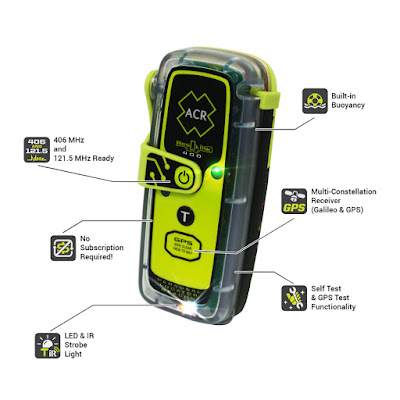
ACR PLB 375
REsQLink+ 406 Buoyant Personal Locator Beacon
· Flip up flap and turn on
F Floats Easy registration and no subscription
Use in any country
If you use it in a real emergency ACR will give you a free
replacement if you share your rescue story with them
To consider:
· Battery has to be professionally replaced by authorized dealer
· Larger than some of the other PLBs available
There is another version – the ACR
PLB 375. This one is very light, fits in your hand, comes with a case, is
waterproof but is based on a paid subscription model and as a major drawback –
doesn’t float! Although no longer manufactured – you can still get them from
various suppliers.
There is also the ACR PLB
Aqualink. Again no longer manufactured, you can still get these units. It has a
digital display and a battery certified for around six years from date of
manufacture. Waterproof to around 10m for ten minutes, it has a typical battery
life of around 30hrs when in use; 406 MHz with GPS with the 121.5MHz homing
beacon and it floats.
The McMurdo
Fast Find 220
· Fast
and simple set up
· Easy
to use – extend the antenna and push the button
· No
subscription
· Linked
directly to rescue coordination centre
· Can
bring rescuers to within 60m of your location - has a 121.5Mhz homing beacon
· Long
battery life
· Lightweight
and compact
· Has
strobe light
· Floatation
pouch included and waterproof down to 10m
To
consider:
· Doesn’t
send out ‘ok’ type messages like some PLBs
· Doesn’t
float and some have reported the cap is difficult to remove in an emergency
Ocean
Signal RescueMe also known as PLB1
Good:
· Seemed
a popular choice amongst many dinghy cruisers who responded to my question
· Very
small and compact
· Lightweight
· Can
be stowed in life jacket
· No
subscription required
· Long
battery life – last 7 years – will transmit 24 hrs plus
· Floats
in its pouch
· Has
a strobe light
· Easy
to use – deploy antenna and hit the on switch
To
Consider
Haven’t
found anything thus far
If you have a PLB which you would recommend, please do get in touch. In the meantime, in the difficult circumstances we all face wherever we are in the world, please, please take care, stay safe and stay in touch.