A blog about dinghy cruising a Welsford 'Navigator' around the coastal waters of SW England
Arwen's meanderings
Hi everyone and welcome to my dinghy cruising blog about my John Welsford designed 'navigator' named Arwen. Built over three years, Arwen was launched in August 2007. She is a standing lug yawl 14' 6" in length. This blog records our dinghy cruising voyages together around the coastal waters of SW England between 2009 and 2025.
Arwen has an associated YouTube channel so visit www.YouTube.com/c/plymouthwelshboy to find our most recent cruises and click subscribe.
Although 'Arwen' has now been sold to another family and is sailing in new water, this blog will remain a source of inspiration and information for those interested in dinghy cruising and sailing the local waters around Plymouth Sound. So, continue to drop us a comment or ask a question and happy sailing and fair winds to you. Steve and Arwen
Ince castle, high above Ince Point hoves into view. Off
the Skipper’s starboard beam, and passing slowly astern, lies Wivelscombe Lake, a
shallow expanse of water ending in several small tidal creeks. And, somewhere beyond
the tall reeds that fringe its edges, lie abandoned quarries and quaysides.
new seal repair on steering compass
Skipper falters a little, the temptation to explore this
backwater lake gnaws into his consciousness. As his focus waivers, Arwen, his little open boat, loses
headway and her bow begins to turn away downwind.
But, a prudent decision is made and the sailor nudges the
tiller to port and heads the bow once more upriver. The building tide is carrying
him towards the confluence where the river Tiddy joins the Lynher; the point
where he will turn northwards up the narrowing Lynher towards the Treluggan Boat
yard on the last of the spring tide.
Wivelscombe Lake will be saved for
another day on a similar building spring tide when he can safely nose into
reed bed lined creeks, nooks and crannies. Maybe he can even dry out on the mudflats
overnight to enjoy the starlight sky and wildlife around him, safe in the
knowledge that the following early morning tide will float him off and he can row back
into the central lake channel and out to the main river again.
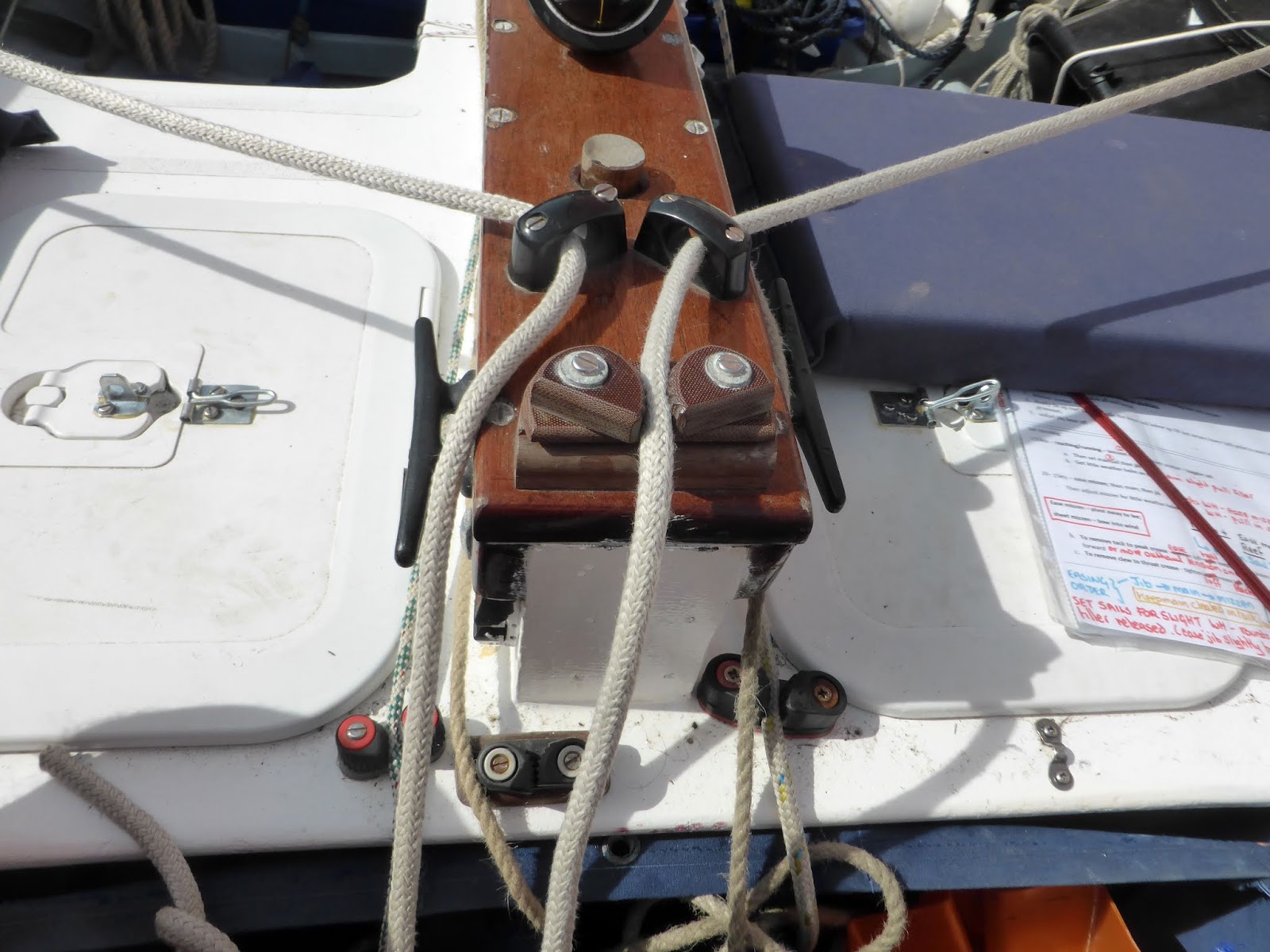
jib sheets back to aft centre-case when single handing
Focused back on his sailing once more, he notes that the
westerly breezes whistling down the channel at a steady 8 – 10 kts are still causing
the water surface to pile up into steep sided little choppy waves; classic wind
against an incoming tide. He tensions the snotter slightly to flatten the sail
and eases downhaul to spill off some of the wind in the upper sail. The gusts
are unpredictable and they spill off the surrounding hills ahead at some 18 –
25 kts. Skipper keeps his eyes forward watching for the crinkly marks across
the small chop that announce the imminent arrival of one of these ‘dry’ squalls. It isn't quite time to consider reefing, not quite yet.
Ignoring his notebook with its courses, bearings and
distances plotted in shorthand, skipper tacks back and forth up the channel, his eyes glued to chart and waters ahead. He is confident that he has sufficient water now beneath him to cross the sand/mud banks that dry out
at some 0.50m or so at low water, mid channel.
Ince Castle (well a house really) with its famous four
turrets slowly falls astern. He’s makes a steady 5.2 kts but this brings occasional dollops of spray as the little dinghy’s bow plunges
into troughs and whilst he is relatively dry, the continual plunge and twist
motion is a tad uncomfortable and, after all, as regular readers know, skipper is prone to the odd bout of sea sickness
now and then.
below the deck, all lines run aft
And 'Now’ is one of those times. So, he focuses his mind on
the story behind the Ince towers. Built in 1642 at the start of the English
Civil war, the house was captured by the Parliamentarians. Ince is Cornish for ‘island’
and the peninsula on which the house is sat is almost one with two quays either-side
of a narrow neck of land at its far north western end. Similar in sound to ‘Ynys’,
the welsh for island he muses.
Anyway, the story goes that Sir Henry Killigrew, a
royalist MP modified the castle just before the Civil War by adding four
towers, one tower for each of his four wives! All of them were kept in their
own tower, blissfully unaware that in the remaining towers they had three other
competitors for his affections! Or so the story goes! Skipper fleetingly muses on the perils or otherwise of having four wives and then wisely decides its best not to pursue that line of thought further.
securely stowed sleeping boards
As the green 'Ince' starboard buoy, with its upstream tilt, passes
by, skipper searches the channel for his next navigation marker, the red port can
‘Wacker Quay’. The twenty foot yacht some quarter mile behind would probably
have to keep to the mid-water channel on approaching the can, for the tide is
still building. Skipper, estimating he has at least 1.4m of depth below him
now, decides to take a long tack across the channel towards Wacker lake and the
tree covered Warren Point.
On this port tack, he hears the revving of a number
of outboards and so ducks down to gain a view under the mainsail. Line
astern and approaching fast are four black inflatables, each holding four Royal
Marines and their kit. A 'raiding'party, ooh that looks fun!
The lead boat anticipating the fledgling skipper’s course, alters a
little to starboard to pass close behind the white dinghy's stern. Waves and smiles are exchanged with each crew as
skipper risks several quick glances over his shoulder at the passing craft but
his focus is pulled back to the course ahead. If he has read the chart right,
and if the muds and sands have not shifted too much, then he should be heading
up the little river channel that flows out of Wacker Lake.
Ahead protrudes Wacker Quay, another nineteenth century
agricultural dockside where barges unloaded limestone and loaded up with lime.
But what many sailors who pass by may not know is that there are also the
remains of a tiny military narrow-gauge railway. In 1886 it ran from the quay
up the hill and overland to the south Cornish coast. Horse drawn trams hauled
stone up the incline and over the hill to the stone masons building the new
Tregantle Fort high on the cliff top. Not for the first time skipper muses on why his brain manages to retain totally irrelevant material and nothing that is of actual importance.
Now the area is a wildlife haven, a popular bird watching
site as just beyond the quay is a car park and the main road down to Cremyll on
the Tamar.
the channel up to St Germans (and to the final stretch of Lynher up to Treluggan)
Closing as near as he can to Warren point
opposite the quayside and at the point where the wind shadow begins to appear, the lone sailor tacks rapidly to starboard, thus giving himself a nice long close-hauled tack
back across the channel, through Dandy Hole, towards Redshanks Point. The wind
God’s favour the amateur sailor and for a short time skipper enjoys a respite
from the constant back and forth tacking that has dominated his voyage up the Lynher
thus far. There is just enough time to lock off the tiller and mainsheet, trim
the sails for self- sailing and pour himself a much-needed cuppa from his flask. He skirts the large anchored yachts lying in the sheltered lee of the hill and the deep water pools afforded them on the outside of the river bend and mentally notes that one of them looks as if it is permanently lived aboard.
As he turns the river bend, the winds drop to a more
comfortable level and, for some obscure reason that Skipper can’t quite work
out, it starts to blow from slightly astern. Not one to look a gift horse in
the mouth, he takes full advantage of the shift, letting out his sails and
raising his centreboard to put himself onto a near downwind run. The chop has
gone, the river surface is mirror like. As he leans over the port bow and stares
into the greeny-brown water, his reflection stares back. It may be an ugly mug
but that smile is something else and says it all!
approaching dandy Hole
Through the narrow
channel between Beacon Hill and St Erth Hill on the eastern side, skipper
gently zig-zags up the channel, spying the Marines pulling their ribs onto the
beach, almost hidden beneath the low oak trees on the western shore. Ahead in
the far distance two paddle-boarders heading downriver, skirt the eastern tide line
whilst somewhere on St Erth Hill lies the chapel that skipper has yet to find. Almost possessing 'Harry Potter' like magical properties, despite several forays out from Redshanks Beach, he has yet to discover this 'mystical chapel. Somewhere, hidden from his
gaze lies this two-storey, late
thirteenth century chapel with its faded medieval wall paintings. The lower
floor was used as a cider house, and still contains its granite millstone and wooden
press; the upper floor, is the chapel itself. Known as Earth Barton Chapel, the
only known medieval document relating to it dates from 1413. Now it is a listed
building.
where the Tiddy and Lynher part company
It is a very hard to find listed building but being the history buff that skipper is, he knows he won’t give in. At some stage in the next couple of
years, he will find and visit the chapel, hopefully with son in tow. After all, what is the point of having a son who is a
medieval history specialist if you can't drag him along occasionally for a free insightful, enthusiastic commentary or two?
Well, progress is being made. A video is on its way showing some of the subtle differences I have managed to achieve in rigging and sail shape. There is still a way to go but we are getting there, thanks to the help of John, Joel, my good friend Dave and many others out there in the FaceBook community. The Jedi side of FaceBook as I like to think of it.
A quick trip out in the sound last week and another quick trip to Salcombe yesterday tested out some of the rig adjustments.
The moving of the mainsail peak right to the top of the aft part of the yard has let to better upper sail shape although please don't as me to explain why - as I have not the foggiest idea.
The new arrangement of an S hook onto which I can attach the parrel bead loop at the tack of the sail is much better although I suspect I am going to have to move the main mast side cleat position.
The loop keeps getting caught on it as I haul up the main sail and so the sail is being prevented from reaching its highest point on the mast as it should. In the interim, I haul the main sail up and then move forward to attach the parrel loop but it is a pain and unnecessary, so the cleat will have to be moved.
The moving of the tack downhaul has been a great success but has more work to do on it. The tack is now held against the base of the mast, much better! The tack downhaul is now a line which runs down through the deck from the tack S hook and attaches to the block and tackle which lies in front of the centrecase. It is here that the problem exists. I still cant get sufficient tension on the luff to eliminate the throat to clew crease before the two blocks in the tackle end up meeting each other. similarly, the line from tackle to tack is a little too short an so restricts the height I can pull the main sail up (by a few inches).
So, tomorrow I will alter the block and tackle positions allowing a greater distance between them and I will alter the length of the line. Next week I will get out again and quickly test them one more time. I am hoping these adjustments will be the final ones and the crease will disappear for good.
The new arrangement for holding the yard against the mast is much better and the steel loops on the yard with the mainsail halyard going through the top one, then around the port side of the mast to tie off on the lower one seem to be doing the trick. I think some further adjustment is needed but I haven't yet quite worked out what it is. I'll get there. I am what some might term a slow learner!
What is definite is that in light winds yesterday at Salcombe, Arwen sailed better than she has in the past. This may be down to the alterations. It may be down to my greater understanding of the rig, developed over this last year or so.
I am going to remove the reefing lines and set them up as I saw Tim do on Facebook. He kindly sent me some photographs of his arrangement, in which he has a line with a hook attached to the aft end of the sprit boom which he can clip onto the first or second reefing cringle in the leech of the main sail. I guess the line with clip is just held in place by a velcro loop when not in use. Similarly at the tack end, he has another short line with another hook that runs from the downhaul hook and this clips into either of the reefing cringles on the luff. It looks much easier and neater than my current system and is worth a try.
And that is it. Over the winter I will paint the hull again as the trailer rollers have taken their toll. The rub rails need a good sanding and filling in places, there are signs of rot in one or two patches. I will put in new circular hatches on the front thwart seat tops and fill in the hatch openings on the thwart sides. that will make those locker spaces far more accessible. Little locks have been installed on all hatch lids already so that if I am camp cruising and go off for a stroll it will potentially slow down or hopefully deter any pilfering light-fingered groats!
I enjoyed sailing in Salcombe yesterday. It was far less busy with plenty of space to tack and drift without being mown down by someone. Much better! Now if only I can find a tide which will be suitable for a bit of camp cruising up the creeks to Frogmore, Southpool and Kingsbridge.
A lucky chance encounter with the Tamar barge 'Lynher' occurred last week. A beautiful sight to behold. It cheered me up no end after the disastrous reefing debacle. very difficult to sail one handed whilst filming with the other on a moving object, so I haven't done her full justice and I owe her owners a huge apology.
If you are interested you can find out more accurate, not from memory, details about her at
Sometimes, out in the garden, when they don't think you are looking, we get furry and feathered visitors. For the last few mornings..................breakfast has been enriched with these cute folk.
I went out today in the sound; an outgoing 5m tide with high tide at 10.09. winds were 7 kts with occasional gusts around 14 kts. Skies were sunny with ominous rain clouds every so often. No rain materialised though.
The intention was to test out the new sail rigging; practise some reefing, sailing under main and mizzen and also eliminating the 'dreaded' sail crease that seems to permanently adorn my sail from throat to clew.
Well the rigging adjustments. In a previous post I outlined how I had moved the sail higher up its top yard and adjusted the down-haul so that it ran down through the deck. I had also devised, on the advice of many, a way of running the mainsail halyard through a stainless steel loop around the mast so that the yard stayed closer to the mast when sailing.
Lets start with the good news, The newly positioned down-haul worked. The tack was held right close to mast base via the parrel beads and I was able to crank on the tension on the luff with no problem.
before...............
after.................
The raised sail up its top yard had the desired effect, raising the tack some 8" at the bottom so that it cleared the coaming with ease.
The upper yard stayed close to the mast and didn't flog or drift away as it has done in the past.
the yard is held much closer but doesn't seem to be hauling all the way up to the mast sheave, so some adjustment needed somewhere
And now the bad news. The crease still remains. I did manage to almost get rid of it by cranking on the luff tension but there are traces of it still there and adjusting the snotter didn't seem to have any impact. Not all is lost though. Next outing I will adjust the tie on point on the top yard and also move the snotter attachment up and down the mand these adjustments may well have the desired effect.
The toll on the rigging from the Salcombe debacle a few weeks ago was made evident when all of a sudden the jib suddenly collapsed and fell to the deck. The block that it runs through at the top of the mast, suddenly split open. On closer inspection, I discovered some internal screws had snapped and the sheave actually had split longitudinally in half. Quite some force a few weeks ago!
Reefing was diabolical. A disaster......with all the vowel intonation afforded the word by Craig, one of the judges, off 'Strictly come Dancing'! I will post some video on my YouTube channel at a later date. Its really cringing stuff!
I got all the things done in the correct order but my reefing lines are too long. The S hooks I use don't transfer smoothly into the luff holes as they should. Because I have led all lines aft to the cockpit, it was difficult to find the right line at the right time. It was, frankly shambolic.
I think I will get rid of the reefing lines. I have a snap hook that attaches the clew to the sprit boom. I can't see why I just don't un-clip it, pull the leech down and clip the boom into the first reefing point cringle on the leech. No need for reefing lines, just lower the whole lot into the boat, transfer the tack down-haul; transfer the clew and then raise the sail again and tidy up the loose sail afterwards.
Sailing just under main and mizzen went well. Tacking using only the mizzen and jib sheets was a partial success. I locked off the rudder, bought the mainsail to just off the transom port quarter and then used jib and mizzen sheet adjustments to tack about. I managed it but it needs improving.
Heaving to and using the mizzen to go head to wind......got that buttoned down. Sailing off a mooring has improved significantly as well although it can be hit and miss.
Sailing under jib and mizzen didn't go well when it came to tacking. Gybing, no problem. Tacking, a disaster!
Still, I did get to see the restored Tamar barge 'Lynher'. Oh my what a glorious sight she was. A real rare treat. it made up for some of the day's disasters!
It is difficult taking photos with one hand whilst sailing with the other! But I hope I caught a flavour of what a magnificent boat she is..................enjoy!
YouTube send me a little update each month about how well my channel is performing. I can access the stat's via YouTube analytics.
Having always regarded the channel as a depository for my vlogs of sailing and travel adventures, a sort of visual diary for my future 80 yr old self, I was somewhat surprised to find that I have gained 156 new subscribers over the last 90 days or so.
In the last 28 days the videos have been viewed 7000 times with 150 likes and 30 comments. I just discovered an extraordinary amount of information in YouTube creator studio analytics, none of which I have any idea on what to do with or how to interpret. I don't even know whether I want to or not.
I do like, very much, the discussion that the comments generate; I definitely know that peoples' kind observations have helped me improve my sailing and dinghy cruising significantly in recent months and I am very grateful to them for their time and analysis. I have certainly made lots of new on-line friends across the UK and the rest of the world and I value the periodic contact with each and every one of them for all sorts of reasons.
Next year my channel, will be officially ten years old and this blog nine years.
Extraordinary!
A 'good' side to the internet and social media I guess.
Go figure!
Arwen’s Meanderings is my long‑running blog about dinghy cruising around the rivers and coastal waters of the South West. For many years I’ve explored these shores in my home‑built Welsford designed ‘navigator’ dinghy - sharing trip reports, coastal passages and the realities of camping aboard a small open boat.
I also focus on maintaining, modifying, and adapting a small cruising dinghy for comfort and safety — from rigging tweaks and storage solutions to onboard camping systems, reboarding aids and practical seamanship.
Alongside the YouTube channel ‘Arwens Meanderings – Plymouthwelshboy’ this blog is a resource for anyone interested in small‑boat cruising, DIY boat improvements, and quiet exploration under sail.
Maurice Griffiths and His ‘Eventide’ Yacht
-
*'Ishani'*
Many yachtsmen will have affectionate memories of sailing and owning boats
that were designed by Maurice Griffiths, and perhaps thousands...
SCOWs & Western Solent
-
Members of the Hurst Castle SC (of which I'm one) have been sharing
pictures of SCOWs sailing in the Western Solent and Keyhaven harbour, with
kind permi...
The America's Cup in Barcelona
-
I haven't posted for a long time, but it's blog anniversary day and I've
recently been in Barcelona where managed to see the America's Cup, so
thought...
Wandering on wheels
-
Some years ago, after a short illness, I wrote a song called ‘I haven’t
finished yet’. It’s about dying – or rather, not-dying, a bucket-list song,
a plea ...
FOR SALE
-
Sailing Just For Fun: Rare opportunity to own wooden gaff cutter Shoal
Waters. Owner retiring. New sails. Yard trailer. Spare original sails.
Ghoster sail....
Moving this blog to Wordpress, Nov 2014
-
I am going to continue this blog on a new *Wordpress *site. I have got
tired of the restrictions and changes that occur to the image library here
on Blogsp...
Capsize
-
I capsized last week for the first time. Ever.
Those who have been here for a while will recognize the eighteen foot long
*Saga*, a design based on the ...
Removing Butyl Tape: Suggestions?
-
*Gardens'* CB case leaks a fair bit when sailing to windward. The case has
three parts: the main trunk; a 'box' (housing the CB uphaul rigging); and a
'c...
CNC files for Welsford Tread Lightly - FREE
-
*NOTE: These CNC files have been updated to add planks and correct
errors. If you have previously downloaded these, please re-download
Revision "A".*
...
WEBSITE INTENTIONS
-
Now I have learned how to access and add to the site, I’ll be posting here
on a regular basis, the intention is to put build blogs, some tips and
hints, ...
New Stretcher - Old Stretcher
-
In rowing there are different definitions of the word 'stretcher,' but this
one seems to work for PicoMicroYacht.
*Stretcher: Also known as the foot stre...
Slack Water Alice.
-
Its been a long time coming.
Designed over ten years ago as a simple two sheet canoe but never built due
to "life" and a lack of confidence, she's final...
Helming a Boat
-
Steering the boat is called helming and the person doing this is called the
‘Helm’ or ‘Helmsman’. You steer by easing the tiller away or pulling it
towar...
Themed Issues —by Joshua Colvin
-
This might come as a surprise to some of you, but the selection of articles
in each of our issues is more-or-less coincidental. Any apparent “theme” is
mos...
done and done
-
Back home just now. Fall cruise on Chesapeake Bay is done, as is the
Sultana Downrigging Festival. Both were very enjoyable experiences.
I received th...